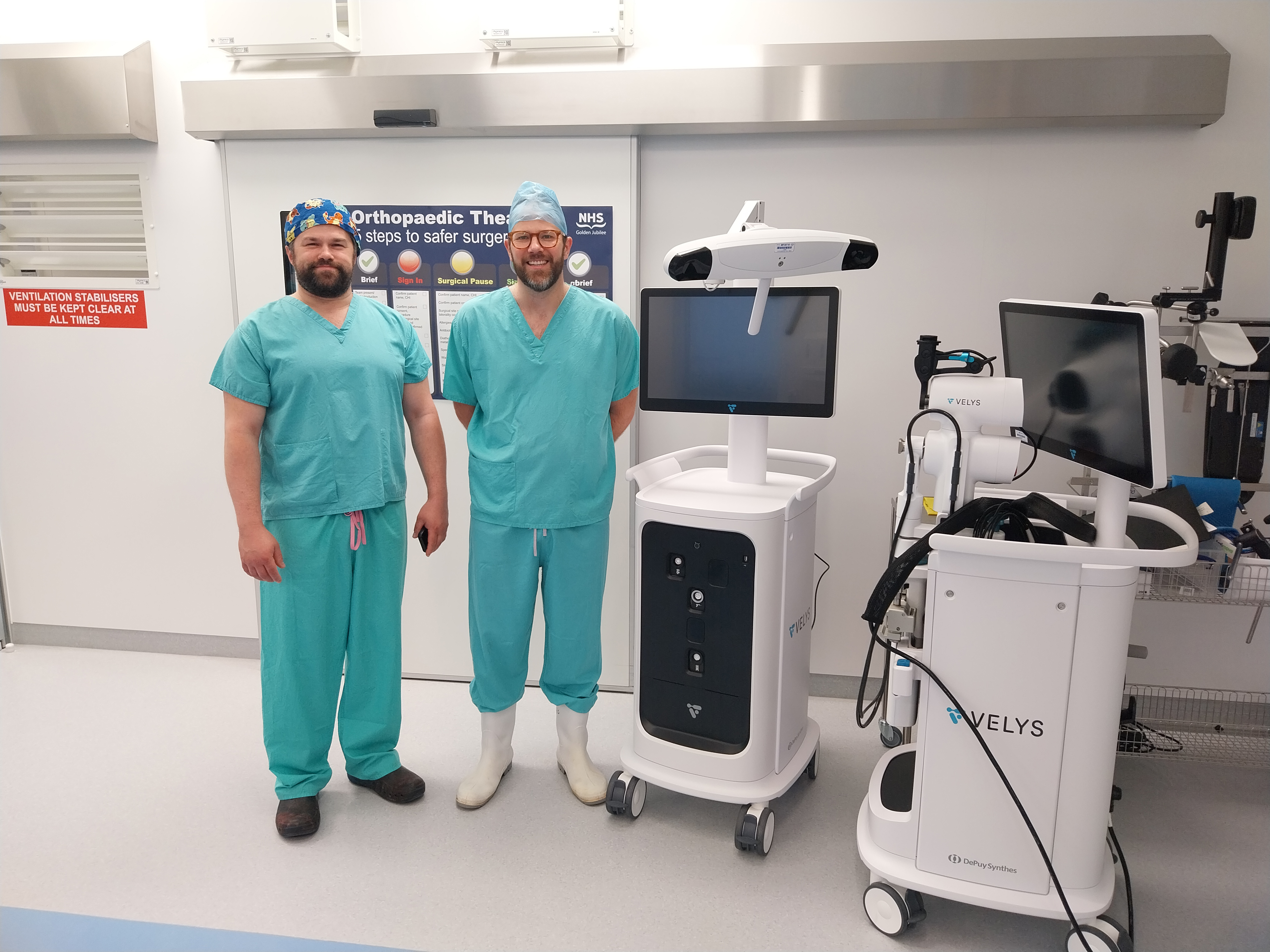
No superpowers required: NHS Golden Jubilee leads landmark MARVEL study into knee replacement surgery
Orthopaedic specialists at Scotland’s NHS Golden Jubilee are carrying out a landmark clinical trial comparing robotic assisted total knee replacements with conventional, non‑robotic techniques, which could help shape how the surgery is delivered for patients worldwide in the future.
The study will evaluate whether robotic assistance leads to improved outcomes for patients, including recovery, joint function and long-term performance.
It will compare standard knee replacement surgery using the ATTUNE™ knee system, with the same knee replacement system implanted by surgeons supported by the VELYS Robotic Assisted Solution at the Golden Jubilee University National Hospital in Clydebank.
As part of the MARVEL study, the team at NHS Golden Jubilee has performed the first VELYS robotic assisted total knee replacement cases in the NHS in Scotland.
The study reflects a collaborative effort, led by NHS Golden Jubilee with support from partners across Scotland, to build evidence on the use of robotic assisted technology in knee replacement surgery for patients with osteoarthritis.
NHS Golden Jubilee is already recognised as a leading centre for robotic surgery across multiple specialties, including orthopaedics, thoracic, general and colorectal surgery. The MARVEL Project builds on this expertise and further strengthens Scotland’s role in delivering high-quality, internationally relevant clinical research.
Consultant Orthopaedic Surgeon and Associate Medical Director at NHS Golden Jubilee, Professor Christopher Gee, said: “The MARVEL Project is about understanding whether robotic assisted knee replacement genuinely improves outcomes for patients.
“While robotics can help us operate with greater precision, this study will determine whether that leads to better recovery, movement and long‑term function.
“For patients, it offers access to advanced technology within a carefully governed NHS research setting, while helping shape how knee replacement surgery is delivered in the future.”
Academic Clinical Lecturer at the University of St Andrews, Dr Andrew Hall, said “This landmark Scottish research will generate unique evidence regarding robotic-assisted knee replacement surgery to support better care for patients. The scale and complexity of The MARVEL Project, made possible through collaboration between university scientists and NHS clinicians, demonstrates our ability to help shape the future of orthopaedic surgery on the world stage.”
NHS Golden Jubilee is leading the study, reinforcing Scotland’s role in delivering high-quality, internationally relevant clinical research. The project also supports equity of access by enabling NHS patients to benefit from advanced surgical technology in a safe research setting.
While robotic surgery has been shown to improve surgical accuracy, we are continuously working to strengthen the evidence base and further demonstrate the positive impact this has on patient outcomes.
Alongside patient reported outcomes and clinical follow-up, the study will make use of NHS Golden Jubilee’s motion analysis laboratory to objectively assess how well patients move and walk after surgery.
Deputy Head of Research at NHS Golden Jubilee, Joanne McGarry, said: “The MARVEL Project is a Scotland-led study designed to answer whether robotic systems in knee replacement surgery genuinely improve outcomes for patients.
“By leading one of the largest trials of its kind, NHS Golden Jubilee is helping to generate the high-quality evidence needed to inform practice, not just across NHS Scotland, but internationally.
“This research strengthens Scotland’s position as a leader in clinical innovation and ensures future decisions about new technologies are based on robust evidence rather than assumption.”
Recently announced as the largest provider of hip and knee replacements in the UK, the MARVEL project continues to build NHS Golden Jubilee’s position as a world leading centre for Orthopaedic care and research.